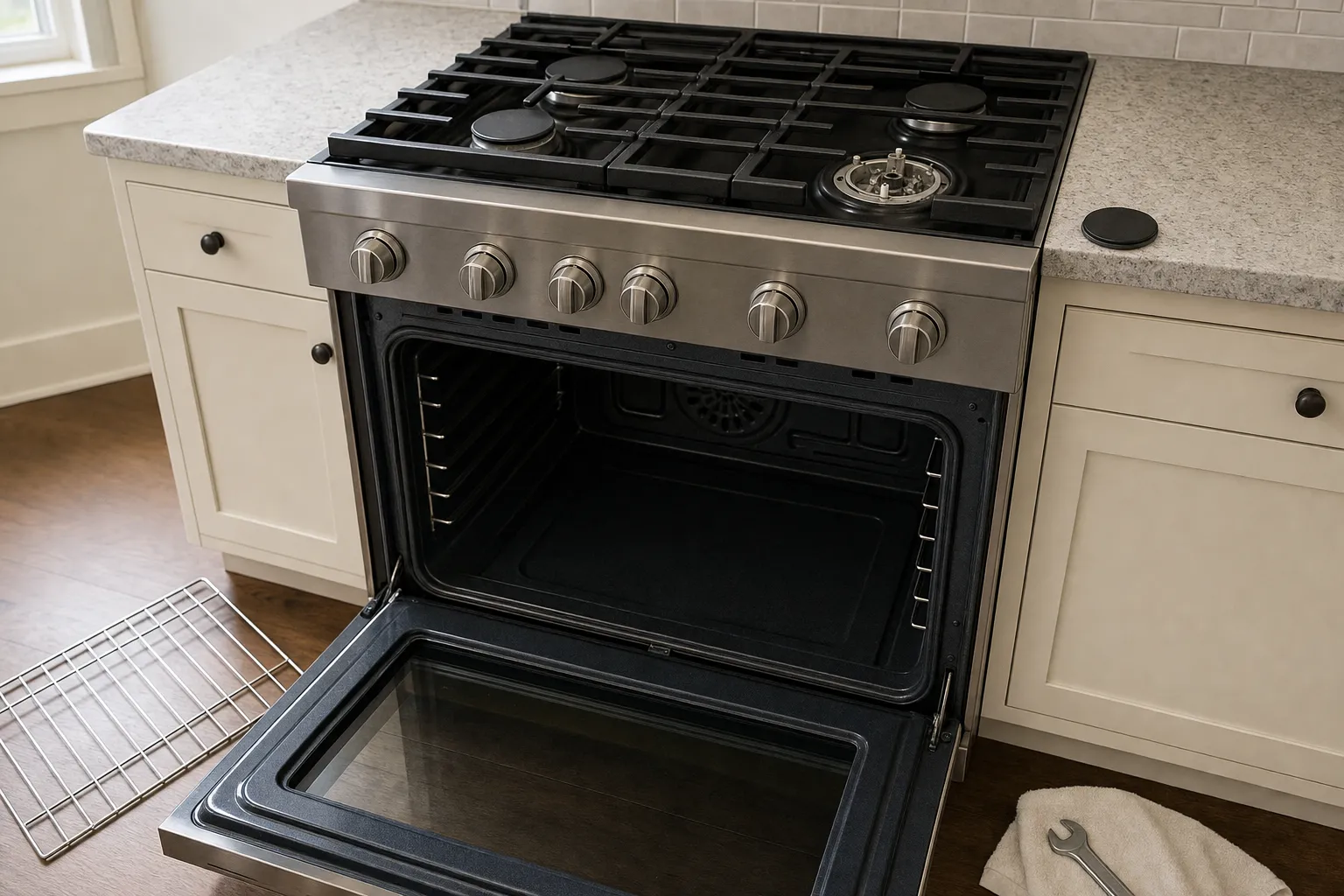
Range Hood Repair
Snow on Grand Ridge, Rain in Olde Town: Servicing a Wolf Range Across 1,000 Feet of the Same City
Why the Highlands' alley-loaded form, not the hill, decides how a Wolf range and hood get in. Summit Cooking Appliance Service, (425) 272-6613.
Written by
Rafael Monteiro
Bench specialtyventilation and blowers
Part of Hood and downdraft problems, the symptom series this guide sits in.
Getting the appliance in at all
Issaquah Highlands was master-planned on New Urbanist principles: ground broken in 1996, first homes finished in 1998, around 3,250 residential units laid out with narrow frontages, shared lanes and garages loaded off the alley at the back. That plan decides how a Wolf range and its hood arrive, where the crew parks, and which door they come through — before anyone discusses the kitchen.
It is a different exercise from Olde Town, down on the valley floor, where the older grid gives you a kerb, a path and a front door. Up on Grand Ridge the residential streets sit roughly 500 to 800 feet above sea level with the ridge rising over 1,100, and the front of the house often faces a pedestrian street with no vehicle access at all. Talus adds steep shared driveways to the same problem.
We are not going to tell you that a few hundred feet of elevation changes how a burner behaves — that is not how we treat it. What the geography changes is access, and access is where installations go wrong.
What Issaquah makes difficult
Three things, all of them about form rather than weather.
Alley-loaded delivery means the practical route into the kitchen is often the back of the house, through a garage and up a flight, rather than the front. A 48-inch range or a pro hood is a two-person carry with a turning circle, and a lane that is fine for a car is not necessarily fine for an appliance on a trolley with a van parked behind it.
Second, these are code-built, tightly sealed houses from 1998 onwards. A tight envelope and a high-extraction hood are in direct conflict: the blower can only move the air that the building will let back in. Without a deliberate makeup-air path, a powerful hood pulls itself into a stall, and the owner experiences that as a hood that roars while the steam still hangs.
Third, the Highlands is a single planned community with common architectural standards, which means an exterior duct termination or a roof cap is not purely a kitchen decision. Anything that changes the outside of the building is worth checking with the association before it is ordered, not after it is cut.
The decisions that get made on install day
Almost all of them are made by the installer, under time pressure, and they are the ones you live with.
The duct route is the big one. Where the shortest path to the outside is awkward, the fallback is a longer run with extra elbows, or a transition down to a smaller duct than the hood was designed for. Both throttle the hood, and neither is visible once the ceiling is closed. A hood rated for high extraction and connected to an undersized run performs like a much smaller hood, and no service call will ever recover that.
The second is the makeup-air question, which in a 1998-onward Highlands house usually gets answered by not answering it. The third is termination: a cap chosen for how it looks against the architectural standards rather than for how freely it opens, with a damper that sticks and a screen that blocks.
The fourth is access. A hood built into a tight run of cabinetry with no service clearance means the next visit starts with joinery, and a range scribed into a surround cannot be pulled forward to reach anything at the back.
What that costs you two years later
It costs you the difference between a repair and a rebuild.
A blower that has been running against a restricted duct for two years is a blower that has worked harder than its duty cycle assumed, and the rattle or grind people report past the second speed is often that history arriving. A damper that has never opened cleanly loads the motor every time it runs. And a hood that never cleared the room properly has been putting grease into the ceiling cavity along that long duct run rather than out of the building.
The Highlands has a specific timing problem too. Because the first homes completed in 1998 and the community built out as one cohort, the original cooking equipment in many of these kitchens is of much the same age and tends to want attention in the same years. Homes further east that changed hands show the same pattern from the other direction: mid-life Wolf equipment that has never had a service visit, because each owner assumed the last one had it done.
Our $89 diagnostic visit is credited to the work when you say yes to it. A hood blower, its control or a sticking damper is priced only after we have seen the run it works against, because no new part repairs a duct that was never right. That is why we look at the duct before quoting a blower.
What to ask before the delivery is booked
Five questions, and they take ten minutes.
What is the actual duct route, its diameter, and how many elbows are in it? Does the hood’s rated extraction have a makeup-air path, and if not, what is the plan? Where does it terminate, and does that termination need association sign-off in the Highlands? How does the appliance get from a vehicle to the kitchen — front door, alley, garage, stairs — and is there a level path for a trolley? And can the unit be pulled forward for service once the cabinetry is finished?
Ask them of the installer, in that order, and write down the answers. In Olde Town the answers are usually simple. On Grand Ridge and in Talus they are not, and the gap between the two is most of what we see go wrong. (425) 272-6613 reaches the same technician who would take the call.
Follow-up questions
Does the elevation difference across Issaquah change how a Wolf range performs?
It is not something we treat as an appliance-specification question. The variables that genuinely change between Olde Town and the top of Grand Ridge are access, delivery routes and the age and airtightness of the housing. Those are what we plan around, and they explain far more of what we find in a Highlands kitchen than the height above sea level does.
The hood is loud but steam still hangs over the range. Is the blower failing?
Often it is not. A blower connected to a long run, extra elbows or a duct narrower than the hood was designed for makes noise without moving much air, and that reads exactly like a failing motor. Have the duct route, diameter and termination checked before a motor is quoted, because a new blower on a restricted run behaves the same way.
How does a 48-inch range get delivered to an alley-loaded Highlands house?
Usually round the back, and that needs planning. Many Highlands frontages face a pedestrian street with vehicle access only from the rear lane, so the route is garage, then whatever stairs sit between there and the kitchen. Confirm lane access, trolley clearance and turning space with the delivery crew in advance rather than on the morning.